Is Rendered or Clad the Right Finish for a Seaside Extension?
in by Oisin Healy in Trades and Renovations
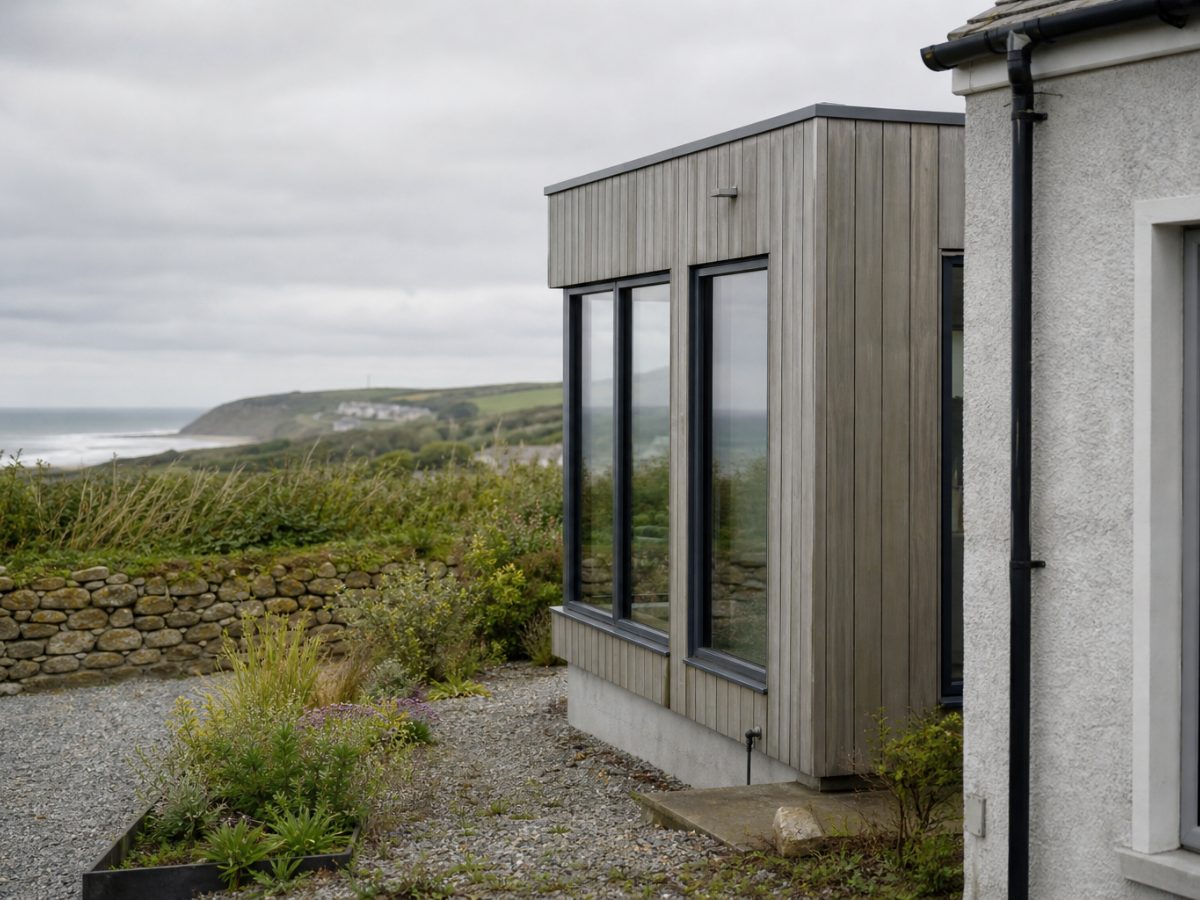
If you're adding an extension to a house near the coast around Arklow, one of the decisions that will come back to bite you if you get it wrong is the external finish. Render or cladding. Both are common, both have their supporters, and both behave very differently once the Atlantic air gets hold of them.
This isn't an abstract debate. Salt-laden wind, persistent damp and the kind of driving rain we get off the Irish Sea put finishes under real stress. What looks fine in a Midlands suburb can look rough and start failing within a few years if it's not suited to this particular environment.
The case for render
Render has been the default external finish on Irish houses for generations, and it's not hard to see why. It bonds to blockwork, it covers a multitude of sins at the building stage, and a decent plasterer can get it looking clean and uniform quickly. On a new extension it gives continuity with an existing rendered house, which matters if you don't want the addition to look bolted on.
The problem here is that standard sand and cement render is relatively rigid. When temperatures swing, when the wall behind it moves even slightly, or when moisture gets behind a hairline crack, that crack opens up. Water gets in, frost pushes it wider over winter, and before long you've got patches flaking off or dark staining lines running down the face of the wall. In a coastal spot that experiences a lot of thermal movement and rarely fully dries out between wet spells, that cycle happens faster than it would inland.
Modern silicone or polymer-modified renders perform noticeably better. They flex a little rather than cracking, and the better-quality ones have hydrophobic properties that help water bead off rather than soak in. They cost more than traditional sand and cement, and you do need a competent applicator who knows what they're doing with the product. Applied well and primed correctly, they hold up well in coastal conditions and need relatively little maintenance beyond an occasional wash-down.
One thing to watch: the junction between the new extension render and your existing wall is a vulnerability point. It needs to be detailed properly, with movement beads and sealant where needed. It's the kind of thing that gets rushed on jobs where the budget is tight.
The case for cladding
Timber cladding, particularly larch or Siberian pine in a featheredge or open-joint profile, has become a genuinely popular choice for contemporary extensions along the Wicklow coast. Visually it can be very striking, and it ages in a way some people find appealing, going from warm golden tones to a silvery grey as the years pass.
The honest reality on the coast, though, is that timber takes work. Untreated timber left to silver naturally tends to split, check and harbour algae in exposed positions. Treated or pre-oiled boards fare better but still need periodic attention, and any area behind a downpipe or under a window sill that holds moisture will start to degrade faster than the rest. If you've ever wondered why garden fences don't last along the coast, the same principles are at play on cladding, just amplified by wind exposure higher up on a wall.
Fibre-cement cladding sidesteps most of that. Boards like Hardie Plank or similar products are dimensionally stable, don't rot, don't swell, and don't need painting every few years the way timber does. They're heavier than timber so the substrate needs to be right, and they can look a little flat compared to real wood, though the better-quality products have improved a lot and can be quite convincing. For a low-maintenance coastal finish that's going to hold its appearance for a long time without much intervention, fibre-cement is worth taking seriously.
Both cladding options rely on a ventilated cavity behind them. That ventilation is not optional in this climate. It allows any moisture that gets behind the boards to dry out rather than accumulating at the wall behind. Get this detailed properly with the right battening and breather membrane, or you'll have problems regardless of what's on the face.
So which one?
It genuinely depends on the specifics of your project. If the existing house is rendered, continuity probably points you towards a good quality modern render on the extension, specified and applied carefully. If you're building something new and standalone, or if the design lends itself to it, cladding gives you more flexibility and in fibre-cement form particularly, it handles the coastal environment with minimal fuss.
What doesn't work well here is cutting corners on either option. Cheap sand and cement render on an exposed gable, or untreated timber cladding with no proper cavity behind it, will both show their age within a few years. If you're also thinking about how the wall construction itself performs, that question often overlaps with insulating older walls without compromising their structure, and the same principle applies: the finish is only as good as what's happening behind it.
When you're pricing the job, ask the contractor specifically what product they intend to use, not just "render" or "cladding." The difference between a standard mix and a quality silicone render, or between treated larch and fibre-cement, matters more in Arklow than it would somewhere drier and calmer.